Quick Answer
Operating-room HMI reliability cannot be determined by panel specifications or a demonstration alone. Medical device OEMs should first define the actual glove, cleaning, lighting, and installation conditions, then validate the final integrated design in three areas: reliable operation with gloves, retained appearance and function after disinfection, and clear recognition of critical information under surgical lighting. Document the results together with test conditions and version information.
Why Operating-Room HMI Validation Must Come First
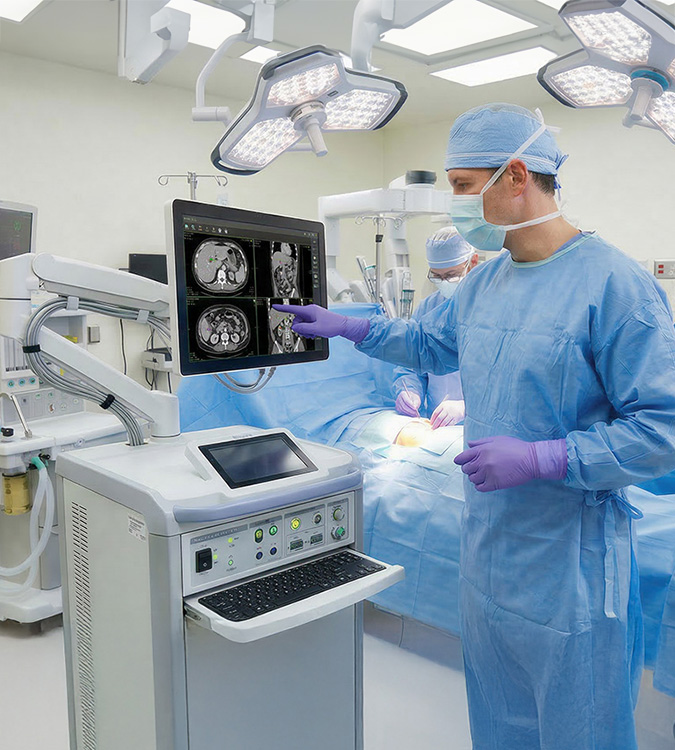
Touch interfaces in operating rooms often support imaging, navigation, anaesthesia, or equipment-control tasks. When clinical staff cannot compensate for a failed interaction with bare hands, or glare makes the display difficult to interpret, the issue extends beyond user experience to workflow and safety risk.
For that reason, technology selection should not stop at “PCAP or resistive” or “with or without an anti-glare coating.” The key question is whether the selected design can produce repeatable evidence under its intended conditions of use.
Before Validation: Define Four Conditions of Use
| Condition | What to Define Up Front | Risk if Left Undefined |
|---|---|---|
| Gloves | Material, number of layers, size, and wet or contaminated condition. | A sample passes testing, but the clinical glove used in practice produces unstable operation. |
| Cleaning | Hospital formulation, concentration, contact time, wiping material, and expected number of cycles. | Only the front surface is tested, while edges, inks, or adhesives deteriorate early. |
| Lighting | Surgical-light position, installation angle, viewing distance, and representative screen content. | The display is readable in a standard room but reflections obscure critical information under surgical lights. |
| Integrated System | Controller, cabling, grounding, power supply, and nearby equipment. | The module functions in isolation, but touch drift or interference appears in the finished system. |
Validation 1: Confirm Reliable Touch Operation with Gloves
Glove-touch performance must be tested on the actual target design. Cover-glass thickness, border ink, bonding method, controller firmware, and system noise can all affect the result. A “touch accuracy” figure without defined conditions should therefore not be used as a purchasing criterion.
- Use the target gloves to test taps at the centre, edges, and corners; include the smallest usable UI button size.
- Include real tasks such as swiping, dragging, zooming, and long presses instead of testing only single taps.
- Based on risk assessment, record missed touches, false touches, latency, and unintended activation, then define acceptance criteria.
- Retest after integrating the touch module into representative mechanics, cable routing, and power configuration to confirm the impact of system noise.
Technology selection note: PCAP can suit flat surfaces, multi-touch, and gesture-based tasks, but glove and noise conditions must be validated. Resistive touch can suit deliberate single-point pressure input, but surface wear resistance and consistency after cleaning must still be confirmed. Test the task first, then select the technology.
Validation 2: Confirm Material and Functional Compatibility After Disinfection
“Disinfectable” is not a claim that can be made for a single material alone. Cover glass, coatings, inks, optical adhesives, gaskets, and edge seals each respond differently to chemical and mechanical exposure. Alcohol, quaternary ammonium, hydrogen peroxide, and chlorine-containing formulations cannot be assumed to produce equivalent results.
- Set the formulation, concentration, wiping material, pressure, contact time, and cycle count according to the actual cleaning procedure used by the hospital or target customer.
- At each stage, inspect for haze, discolouration, cracking, coating failure, edge ingress, and changes in surface adhesion.
- Retest touch, display, and optical performance; assess sealing and structural integrity where necessary.
- If antimicrobial, antiviral, or infection-control benefits are to be claimed, separately confirm the scope of the claim, test method, and applicable market requirements.
Validation 3: Confirm Readability Under Surgical Lighting
Readability in high-intensity light is not determined by brightness alone. Panel contrast, cover-glass reflection, AG/AR surface treatment, bonding construction, installation angle, and screen design all affect the visual result. Under representative surgical-light positions and viewing angles, users should be asked to identify critical information required for real tasks.
| Check Item | Recommended Observation |
|---|---|
| Reflection and Glare | Whether warnings, values, image details, or operating buttons are obscured. |
| Contrast and Text Size | Whether critical information remains identifiable across different backgrounds and brightness settings. |
| Parallax and Touch Alignment | Whether tapping from representative viewing angles produces noticeable positional offset. |
| Surface and Bonding Construction | Assess the optical, abrasion-resistance, and chemical-compatibility trade-offs associated with AG/AR treatments and optical bonding. |
Validation Evidence to Request from Suppliers
| Documentation | What to Confirm |
|---|---|
| Glove-Touch Report | Glove model, design revision, tasks, sample size, failure definition, and results. |
| Chemical Compatibility Report | Disinfectant formulation, conditions, cycle count, acceptance criteria, and post-test condition. |
| Optical Data | Surface treatment, reflection or readability assessment conditions, bonding construction, and limitations. |
| Integration Support Documentation | Controller settings, grounding/shielding recommendations, change management, and traceability records. |
Frequently Asked Questions
1. Will PCAP always work through surgical gloves?
Not necessarily. It must be validated with the target gloves, cover-glass construction, controller settings, and system-noise conditions.
2. Is IPA alone sufficient for disinfection testing?
No. Use the formulations and wiping procedures actually adopted in the target clinical environment.
3. Does an AG or AR coating guarantee readability under surgical lighting?
No. The display must still be tested with representative light sources, installation angles, and screen content.
4. Is optical bonding always necessary?
No. It is worth evaluating when reflection, parallax, or contamination in the air gap are key risks; adhesive compatibility with cleaning must also be confirmed.
5. Can ISO 13485 replace finished-device safety validation?
No. It is a quality management system. Finished-device safety, EMC, and market-access requirements must still be completed according to product requirements.
6. When is the best time to conduct integrated-system testing?
Test when the mechanical design, cabling, and power configuration are close to final, then retest after significant changes.
Conclusion
The quality of an operating-room HMI should be judged by validation evidence gathered under real clinical conditions. Defining glove, disinfection, surgical-lighting, and system-integration conditions in the requirements—and recording test results in traceable documentation—helps OEMs identify risk earlier, before volume production.
Planning a touch display interface for the operating room? Discuss your use conditions, structural constraints, and validation needs with Higgstec to build a more practical module-selection and test plan.
Book a Technical Consultation